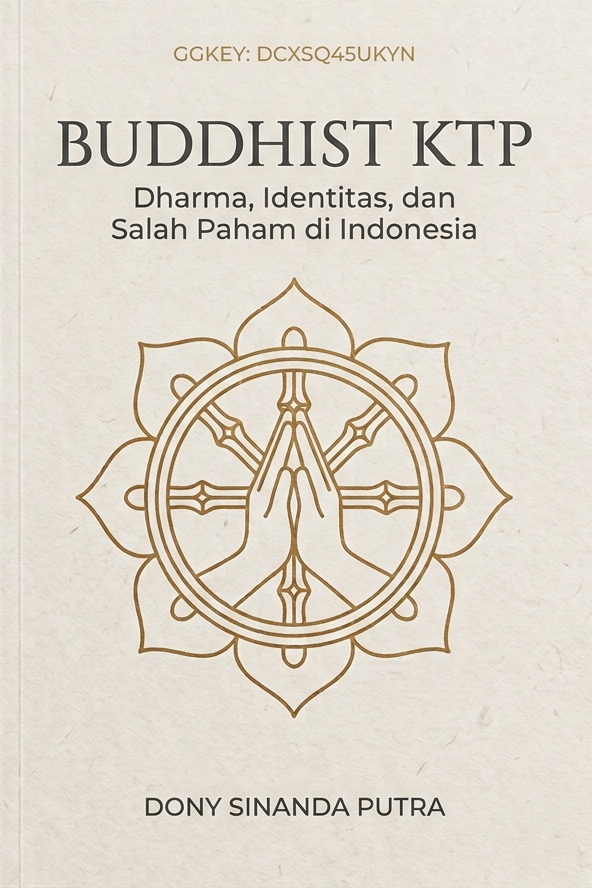
Buddhist KTP
Dharma, Identity, and Misunderstanding in Indonesia
This is not a book about religion. It is a book about how religion gets read — and why so much of the misreading comes down to using the wrong dictionary.
Buy on Google Play Books
Ebook format — read on Android, iOS, or web. Instant access.
Buy now →312 pages · 39 chapters · 3 appendices

Scan to purchase
Not about religion.
About how religion gets read.
In Indonesia, the religion column on the national identity card — the KTP — is not merely administrative data. It is a stage upon which identity is negotiated, judged, and often translated into the language of the majority just to be considered legitimate.
Writing from a position neither fully "inside" nor fully "outside" any single tradition, this book asks the questions that rarely get asked: why is bowing to a teacher treated as personality cult, why is meditation suspected as sorcery, and why is Dharmic openness so often read as weakness?
The answer lies in the wrong dictionary. Indonesian public discourse has long been shaped by a single template for what "religion" is supposed to look like: one personal God, one sacred text, one clear system of belief.
Buddhist KTP is not just a book about Buddhism. It is a portrait of social psychology — showing how a minority survives, from Tridharma to Viparyaya, from the irony of cultural amnesia to resilience through Padmasambhava.
— from the Author's Preface
Six phases — from KTP to Cosmos
The manuscript's cognitive flow is a spiral of expansion — not a list of topics, but a single movement from the wound of misrecognition outward to cosmic compassion.
The Wound & The Wrong Dictionary
Ch. 0–3The administrative identity of "Buddhist KTP." The realization that the problem is semantic — āgama itself has been narrowed. The state forces a "God" label on a non-theistic tradition.
Building the Inner Citadel
Ch. 4–17Protection, respect, ethics, breath, language, equanimity. The internal foundation that makes it possible to live as a minority without losing the center.
Facing the Pluralistic Storm
Ch. 18–22Bhinneka Tunggal Ika is not a cliché — it is a philosophical shield. The dangerous undercurrent: the quiet erosion of self.
The Embodied & Social Reality
Ch. 23–29Food, fear, body, hybrid identity. The breakthrough: Viparyaya. The resolution: Padmasambhava as a model for absorbing difference without self-erasure.
The Cosmic & the Microscopic
Ch. 30–35Lunar and solar rhythms, the five layers of the self. Numbers and symbols reclaimed as functional technologies of attention. The meditative peak: Dhyāna.
The Return to Compassion
Ch. 36–38Bhikṣā, Tonglen, Atīśa Dīpaṃkara. The lineage of compassion from Suvarṇadvīpa to Tibet. The manuscript closes with a blessing — not a victory.
Sabbe sattā bhavantu sukhitattā.
Not only for Buddhists.
- Indonesian Buddhists who have ever had to explain their tradition to a neighbor, employer, or the state
- Yoga practitioners, Tridharma communities, Penghayat adherents, and anyone whose tradition doesn't fit the dominant "religion" template
- Readers interested in pluralism, social psychology, and identity dynamics in contemporary Indonesia
- Academics and journalists researching religious freedom, religion law, and minority representation
- Anyone who has wondered: why is it so difficult in Indonesia to be different and still be considered normal?
The In Depth page contains the full architecture of this book — including all 39 chapter titles, detailed phase analysis, and its connection to the Beyond Tolerance psychology research program.
In Depth →